If you optimize everything, you will always be unhappy.
Donald Knuth
It would be very discouraging if somewhere down the line you could ask a computer if the Riemann hypothesis is correct and it said, 'Yes, it is true, but you won't be able to understand the proof.'
Ronald Graham% This program is copyright (C) 1985 by Oren Patashnik; all rights reserved.
% Copying of this file is authorized only if (1) you are Oren Patashnik, or if
% (2) you make absolutely no changes to your copy.
Oren Patashnik
Day 3: The third page of the introduction to Concrete Mathematics.
Another title page, but this time with the authors: Ronald L. Graham,
Donald E. Knuth, and Oren Patashnik. Let's get to know the authors.

Ronald L. Graham
 I bet you would't have guessed that Ronald Graham is the Ex President of the International Jugglers Association? There is a long history of computer scientists and juggling. No.. really. Look here, and here, and here, and you have to watch this one here. That last one is good.
But wait, there's more:
In college days, Ron was part of a circus act, called the Bouncing Bears. He was on stage with Cirque du Soleil and in an issue of Discover magazine about the Science of the Circus. He was a qualified judge for international trampoline competitions and has a unique bungee trampoline for daily exercise.I'm not kidding. Check this out:
- Ron Graham's Special Page

Oh, and he did some computer science stuff too:
Several mathematical areas were started by Ron's work, such as worst case analysis in scheduling theory, on-line algorithms and amortized analysis in the Graham's scan in Computational Geometry, and of course, his favorite topics on Ramsey Theory, and the recent work on quasi-randomness. Ron's mathematics was highlighted in the nomination article written by Gian-Carlo Rota for the first contested election of AMS President. (He won ). He received the Steele Prize for Lifetime Achievement in 2003.And of course helped write the wonderful book we are about to read.
- Ron Graham's Special Page
Donald E. Knuth
So who is this Donald Knuth that the blog is named after?
Author of the seminal multi-volume work The Art of Computer Programming[3] Knuth has been called the "father" of the analysis of algorithms, contributing to the development of, and systematizing formal mathematical techniques for, the rigorous analysis of the computational complexity of algorithms, and in the process popularizing asymptotic notation. ("TAOCP"),
In addition to fundamental contributions in several branches of theoretical computer science, Knuth is the creator of the TeX computer typesetting system, the related METAFONT font definition language and rendering system, and the Computer Modern family of typefaces.
Not too shabby. And here's a picture:
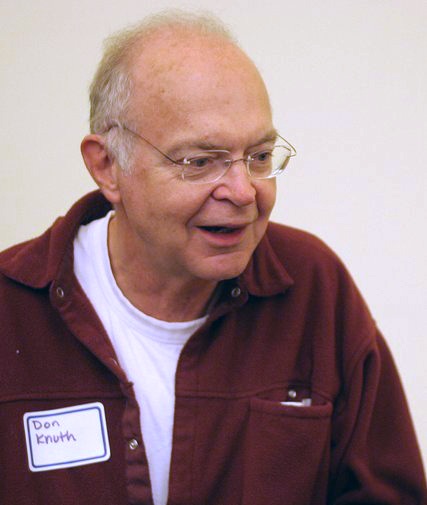
Donald Knuth has a reputation for having a good sense of humor.
He used to pay a finder’s fee of $2.56 for any typographical errors or mistakes discovered in his books, because “256 pennies is one hexadecimal dollar”.
-wikipedia
He unfortunately had to stop due to bank fraud. Here' s a good anecdote about Concrete Mathematics from its preface:
“When Knuth taught Concrete Mathematics at Stanford for the first time, he explained the somewhat strange title by saying that it was his attempt to teach a math course that was hard instead of soft. He announced that, contrary to the expectations of some of his colleagues, he was notTheory of Aggregates, nor Stone’s Embedding Theorem, nor even the Stone-Čech compactification. (Several students from the civil engineering going to teach the department got up and quietly left the room.)”
Donald Knuth is one of the fathers of computer science. Unfortunately, not many people make it through all of the books in TAOCP. I have personally only made it about 3 pages in. The books are well written, but the material can be difficult.
If you think you're a really good programmer. . . read [Knuth's] Art of Computer Programming.... You should definitely send me a resume if you can read the whole thing. -Bill Gates
Oren Patashnik
Oren seems to be the least famous of the three. He was a graduate student of Knuth's and assisted Graham and Knuth in the writing. According to wikipedia:
Oren Patashnik (born 1954) is a computer scientist. He is notable for co-creating BibTeX, and co-writing Concrete Mathematics: A Foundation for Computer Science. He is a researcher at the Center for Communications Research, La Jolla.
 And I thought this was a nice highlight:
In 1980, he used 1500 hours of computer time to prove that Qubic (a sort of 3-Dtic-tac-toe) can always be won by the first player.
So those are our three authors. And finally, the book is published by Addison-Wesley:
Addison-Wesley is a book publishing imprint of Pearson PLC, best known for computer books. As well as publishing books, Addison-Wesley distributes its technical titles through the Safari Books Online e-reference service.
-wikipedia


No comments:
Post a Comment